Showing posts with label culture change. Show all posts

30 June 2009

The "Strong Sustainability" Paradigm

Recently I've been motivated to think about what peak oil and money systems have to do with where we need to focus our efforts for a better future. Here is what I've come up with:

The Strong Sustainability Paradigm


The current economic crisis is not about the conflict between capitalism versus socialism, left versus right or about questions of globalisation versus social justice. The current crisis happens at a time when we start feeling the impacts of climate change and the degradation of the biosphere on a large scale. It has become an opportunity to examine our perceptions of our personal and economic relationships with the natural world. The current crisis gives us an opportunity to move from the business as usual of economic growth to an understanding and adoption of ecological economics.

How can we find a real response to the needs of climate change and challenges of our times? In terms of current popular culture, a fundamental realignment of approach and priority and a culture shift is needed. We need an approach of Strong Sustainability. Changing the conventional order of things, this approach postulates that the economy is a subset of society (humanity) and that society is a subset of the ecology. All activities therefore ultimately need to conform to ecological limits.

Ecological systems operate in cycles and are self-regenerating. Consumption and the use of biosphere services need to happen within the limits of this regenerative capacity.

A successful reorientation is possible and it requires that we adopt a new set of ethics. In the new set of ethics, we leave the purely utilitarian approach behind and adopt a set of ethics that values life and the integrity of all systems that support life above all else.

The Ecology
The success of this approach and the the application of policies can be measured by a set of specific indicators. What must be measured, first and foremost, is the health and quality of the ecology/biosphere. Among the available indicators to measure this are the ecological footprint, biodiversity indicators, air, water and soil quality standards.

Society
The next priority must be the quality of life and the development of human society. There are indicators that can be used for hat purpose, like the Human Development Index, and other Quality of Life measurements.

Economics
“The economy is a wholly-owned subsidiary of the environment.” What does that mean? Not only does it mean that economic institutions and systems need to function in accordance with nature, but it also means that economic indicators come in third priority only, after the more important ecological and societal indicators. Since a strong sustainability approach cannot accommodate an ever and exponentially growing economy, a set of indicators must be adopted which reflect the quality of economic activity, rather than just its size and trough put. One such such indicator may be Genuine Progress Indicator (GPI).

Economic Transformation
Following the principle of perceiving the economy as a subset of ecological activities, economic systems, institutions and policies need to be designed in a way that they permit and promote a steady state and ecological economy which flexibly adapts to natural cycles of growth and decline. Economic activity can be steered by ecological taxes, a social safety net that promotes social justice and a raft of other policies. Institutions like the financial and money system and values that are built on the premise of unending growth need to be abolished and replaced with systems that can usefully act within the natural limits of nature.

The financial system needs our special attention because it is the 'operating system' of the economy. The global economic growth imperative is inherent in the nature and integral to our current money system, and as a result one of the main drivers of global warming and environmental destruction. Any challenge to the established economic growth paradigm must not just include the regulation of the financial industry, but extend to a fundamental reform of the money system. Invention and transformation can draw on countless experimental as well as established and proven alternatives to the current financial infrastructure which is based on bank issued debt money with compound interest.

Conclusion
Such an approach is a significant departure from the conventional way of thinking. It will not only provide a new vision for the future, but also require workable ways of transitioning from the current economic thinking to a new economy. Because in current practice economics and financial profitability and safety are the final bottom line, any vision of ecological economics and the policies for transitioning to it must be able to address any economic concerns individuals and the business community might have. We must be clearly able to show that the welfare of people is guaranteed even if we work within the ecological constraints of the planet and the land and abandon the growth imperative, and that overall we will be better off this way, rather than when we keep ignoring the ecological limits.

28 March 2009

Understanding 'Zero'

We have a dire need to expand our thinking around the understanding of money and currency. We also need to escape the box of the perceived need for never ending exponential growth. Using a mutual credit system could give us just about what we need to expand our thinking. Here, the concept of 'Zero' is an essential ingredient. Here it's not about the flow of money, or about having more and more – here it is all about relationships!


(Image from FreeFoto.com)

What does “Zero” stand for?
- Zero stands for the sum of all currency in the system. In other words, if one adds up all the negative account balances and then adds all the positive account balances, one should arrive at zero. This will be true as long as a foolproof accounting system is used where every transaction is recorded on both the credit side and the debit side.

- Zero stands for balance. However, that balance won’t be guaranteed if the Zero point is shifted by giving away “free” Points or if the balance is upset by granting larger credit limits than debit limits. As long as balance is kept, Green Dollars in circulation keep their value.
Zero stands for the dynamic centre. In order for a mutual credit system to work, everyone needs to engage in equal and balanced giving and receiving. There are always enough points in the system for trading. Participants need to trade through Zero at least once per year, or even better, several times per year.

- Zero stands for the fact that relationships are more important than numbers. We’re conditioned in this society that “more is better” and we need to “get rich.” Both propositions are meaningless in the context of a mutual credit system. In such a system we find economic security not because we accumulate, but because we build relationships with other people.

- Zero is also the symbol of a circle, which stands for the community of which the participant is a member. In the conventional economy, we must all fend for ourselves in competition with everyone else. In a mutual credit system, we’re all in it together. When creating the means of exchange (Points, Green Dollars or any other unit), we do so ourselves in a transaction with another community member. What counts are only three positions in relation to the system: we’re either in dedication to the community because we’ve consumed ahead of providing something, or we’re in “recognition” to the community because we’ve provided before consuming. We also stay within the limits that we as a community have all agreed to. The community needs all three, and therefore both dedication (debit) and recognition (credit) are valued equally. The only other necessary ingredient is solidarity with the community: when we seek to trade to fulfil some of our needs and wants, we need to look within our own community first (buy local, so to speak) before going into the dollar economy. A mutual credit exchange suffers seriously if members abandon their solidarity with the community.

- And finally, Zero is our balance when we join and Zero is our balance when we leave. We enter the system at Zero, and the only acceptable way out is at Zero again. Otherwise, a convenience to the individual creates a problem for everyone else in the circle.

Understanding and living the concept of Zero require a culture of “we,” a culture of community. Calling the unit of currency in a mutual credit system a “dollar” is unhelpful, because it tricks us into thinking and behaving according to our mainstream competitive consumer culture. Applying the concept of Zero helps maximise trade while preserving equilibrium within the community and supports functional, fulfilling relationships between individuals and the community. By making everyone a winner, a well-maintained equilibrium increases the quality of life for the whole community.

30 March 2008

Still a long way to go ...

This is a letter sent the to The Press, in response to the Earth Hour.
http://www.stuff.co.nz/thepress/4456988a6009.html

The Earth Hour in Christchurch was a success, far exceeding the expectations of the organisers. Yet, it was a small step on a long path. In order to succeed, our society needs to transition to a culture of sustainability. The 12.8% of reduction in electricity use during one hour, preceded by a long media campaign needs to lead to comprehensive Energy Descent Plans for each village, town, city and country. Our mentality of 'more is better' will have to be replaced with the common sense of 'less is better' and our economic systems and ideology need to turn away from the need of constant growth at all costs. Still a long way to go, indeed ...

23 March 2008

'Official Status' of Transition Towns

'Transition Towns' is a new movement that has arisen in response to climate change and peak oil (and peak other stuff). People and groups in the UK have been pioneering the ideas and concept.

They've also started to formalize processes in some ways, and one of them is setting out criterias of what is to constitute an 'official' transition town. This of course has stirred up some discussions, notably on the New Zealand discussion list.

Here is my response to the thread:

Thank you very much for bringing this up. I think this is a very important issue. It is important because in order to succeed with transitioning to a better and sustainable future we need to be
grounded in our local environment. This not only in terms of food and energy production, but also in terms of economics, culture, philosophy and worldview. I noticed that we had some discussions in our Christchurch group on the same subject of this business of 'official status' as well, without coming to a final conclusion on what that is supposed to mean of us.

While things like an 'official status' are clearly hangovers from our current traditional culturally imperialist midset, I also have an explanaition from the permaculture point of view. One of the
permaculture principles my teachers tought me was put into following words: "everything gardens". Every participant in the system is trying to influence its immediate environment in a way as to create more livable conditions for itself to survive and spread. Applying this principle to the social and economic sphere helps me understand a lot of what is going on.

Everyone is constantly engaged in manipulating his or her environment and relationships with others in a way that suits his/her own character and purposes. This is neither good nor bad - this just is. All, everyone and everything is doing it all the time. But just because someone/something else is in the process of remodelling his/her/its systemic environment to suit its own purpose/character doesn't mean that we have to submit to those efforts ourselves.

As far as I'm concerned, if someone declares his/herself as 'official' - then this is just their own problem and not mine. I only have to decide what I need to do in order to stay true to myself. In terms of the Transition Towns movement this might mean: Engage in networking to learn from others, if they have to teach us something useful. Yet on the other hand we might ignore what comes across as cultural imperialism and we should not feel obliged to submit to some 'official
guidelines' that are handed down from some gurus on the other side of the world.

To me, the Transition Town's movement is about more than just energy descent. In order do succeed, we also need to create a new culture that is steeped in the systems' approach, rooted in the local environment of our planet and has evolved to embrace cultural and spiritual diversity.

So, Gail, thank you for sharing your thoughts. I think is it absolutely necessary that we are clear on why we are engaging the transition process as well as how we are relating to others who are
engaged in the same process, locally as well as internationally. While we are often engaged in discussing and learning the nuts and bolts - developing an understanding of the big picture of underlying dynamics is often more challenging.

31 October 2007

Abandon the outdated ...

"You never change things by fighting the existing reality. To change something, build a NEW model that makes the existing model obsolete."

- Buckminster Fuller

* * * *

"Gandhi is an example of the power of a unified state of consciousness. He was never 'against'. His consciousness was not in a divided state. He was always 'for'. So he acted, spoke, and transmitted into the collective an undivided state of consciousness. That's what has all the power. That's really significant... am I divided?"
-- Adyashanti

03 April 2007

The Paradox

Today we have bigger houses and smaller families;
more conveniences, but less time;

we have more degrees, but less common sense;
more knowledge, but less judgment;

We have more experts, and also more problems;
more medicine, but less wellness.

We spend too recklessly, laugh too little, drive too fast, get to angry too quickly, stay up too late, get up too tired, read too little, watch TV too often, and pray too seldom.

We have multiplied our possessions, but reduced our values.
We talk too much, love too little and lie too often.

We‘ve learned how to make a living, but not a life;
we’ve added years to life, not life to years.

We have taller buildings, but shorter tempers;
wider freeways, but narrower viewpoints.

We spend more, but have less;
we buy more, but enjoy it less

We've been all the way to the moon and back,
but have trouble crossing the street to meet the new neighbour

We've conquered outer space, but not inner space.
We've split the atom, but not our prejudice;

we write more, but learn less;
plan more, but accomplish less

We've learned to rush, but not to wait;
we have higher incomes, but lower morals.

We are long on quantity, but short on quality

These are the times of fast foods and slow digestion;
tall men and short character;
steep profits and shallow relationships.

More leisure and less fun;
more kinds of food, and less nutrition;
two incomes, and more divorce;
fancier houses, and broken homes

01 April 2007

Section 59 – or what about non-violent parenting?

(Will the popular childrens series Pingu be banned in New Zealand?)

Currently there is an interesting public discussion making waves in New Zealand. It is about the proposed repeal of section 59 of the Crimes Act, brought before parliament by Green Party MP Sue Bradford. The purpose of this Bill is to stop force, and associated violence being inflicted on children in the context of correction and discipline.


The discussion has been noisy, even strident and unpleasant. Is this just a popular political side-show, or how deep does this issue really go? If we can believe the opponents of the bill, then a police state is being born here, and personal freedom of parents to discipline their misbehaving children is severely restricted or even being taken away. An essential part of the Kiwi way of life and culture is about being legislated away and lost – or so most god-fearing Christians like make us believe.


In our constant endeavour to create a civilised and evolved society where do we draw the line? Should it be legal to hit your children, but not your wife and animals? In the Koran, the holy book of Islam, the line is drawn in Surah IV, Verse 34, which states that if the woman doesn't obey the man, they should be beaten (though the situation is not always as clearcut). Now, we all 'know' that Islam is the enemy of our culture – they mistreat women and sanction their beatings. We in New Zealand, would never do that - yet it should be our god-given right to beat our children?


This society is still steeped in institutional violence. How otherwise would one explain the uproar at a bill that basically wants to make non-violent parenting the norm? Our violence is not just against children and a variety of other people, it is also against nature and the environment. We've abused and mistreated the planet to an extent that we are now facing global climate change.


We may have experienced incredible technological advances over the last century. We have also learned a lot about how to educate children, and we know that hitting them is counterproductive if anything. However, we also need to match those advances with moral and ethical evolution as well. The opposition to this bill just shows that we have much more difficulty to mature ethically and morally than we have adopting new technological gadgets. And it shows that we still have long way to go until a non-violent society becomes the norm.


03 February 2007

What is Sustainability?

In my understanding of sustainability it is not "if" some area of our society has relevance to sustainability - all have! To me, sustainability is a way of looking at things (and at the same time a way of life). Either you look from/through a paradigm of sustainability - or not!

In the future it will be irrelevant if you are Christian or Muslim, Chinese or American - the cultural divide will be between those who live a sustainable life-style and those who do not (at the expense of everything and everyone else on the planet)!

15 November 2006

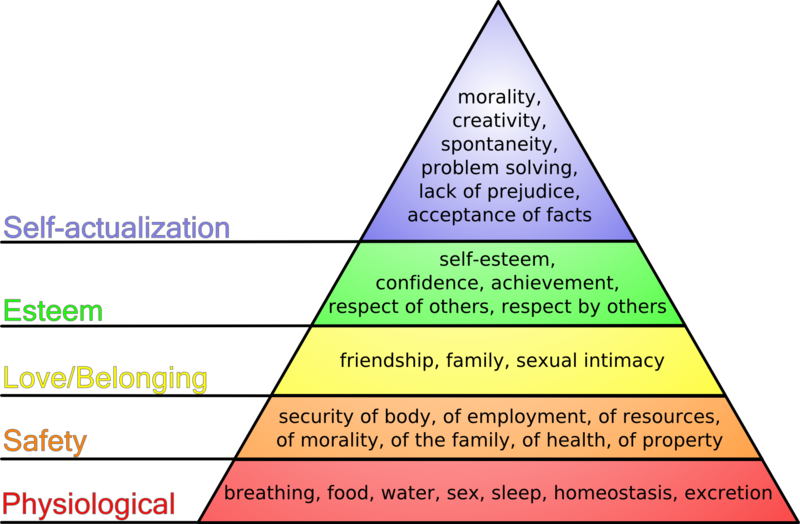
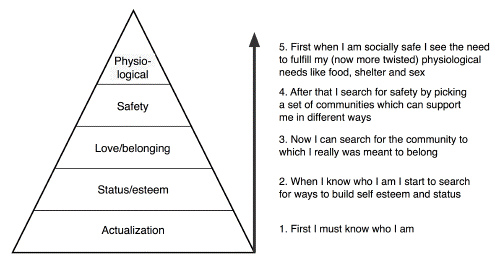
Is Maslow's Pyramid upside down?


When I first time came across Maslow's Pyramid many years ago I intuitively felt it was not correct - it seemed upside down. But who am I to argue with a respected scientist?

Recently I saw that others must be thinking the same way as me:


Maslow's upside down world is not surprising, given that modern western science doesn't perceive and recognise the metaphysical - how would it ever guess that self-realisation is actually the at the core of human experience, and not just a comfortable add-on once we have satisfied all our physical needs.

Satisfying physical needs is only a means to get to the core of what it means to be human: self-realisation. Once having understood this, we need to ask ourselves to what extent we need to reorganise our culture and civilisation, and put the real needs into the centre and not the physical (consumer) needs and wants.

23 October 2006

What is Abundance?

abun·dance
1 : an ample quantity : PROFUSION
2 : AFFLUENCE, WEALTH


While I was writing the previous post about the display of reckless consumerism in a recent new age film, I was wondering how many people really do understand the concept of 'abundance'? This seems to be one of most difficult concepts to grasp, more so since we live in a civilisation that has at the core of its defining story the concept of scarcity.

Our minds are constantly exposed to the message of there is 'not enough', daily reinforce by mass media, advertising and political propaganda. The definition of economics “is the study of human choice behavior and how it effects the production, distribution, and consumption of scarce resources.” We are trained from a young age that we need to compete, otherwise we lose out in this world. And if you don't believe that there isn't enough, just look at those between 1 and 2 billion people on this planet who are unfortunate enough to be forced to live on 1 Dollar or less a day ...

How would one ever be able to grasp (and trust!) the concept of abundance? How can we get out of our collective trance of 'scarcity'? Bernard Lietaer believes that there are archetypal forces at work: of all the major archetypes at least one is thoroughly suppressed in western thought and culture - the one he calls the 'Great Mother', the unconditional provider of nurturing. Instead we experience it's shadow instead: fear of scarcity and greed.

How can we change our cultural story of prosperity from one of fear of scarcity to one of abundance where everyone is cared for? It is not the carrying capacity of our planet that is in question here. Even today, if all resources were distributed equitably, everyone would have enough. Poverty and deprivation are first of all signs and indicators of failure of a capitalist neo-liberal market economy.

How would we characterise an economic story that provides for all? The biological systems of life work constantly in an abundance mode. For one thing: nothing is wasted, every thing is recycled and of use and value for somebody/something else. Furthermore, abundance is when we have the ability to both share and conserve energy and matter, and when we freely share information in order to grow the potential of the whole.

True abundance depends on frugality, mutuality, and sharing. True abundance is possible if we recognize that we are all part of a community and that healthy communities depend on healthy individuals, and vice versa.

21 October 2006

"The Secret" - New Age Economics of Abundance


"This is 'The Secret' to everything - the secret to unlimited joy, health, money, relationships, love, youth: everything you have ever wanted."


"The Secret" is the latest hit-movie sweeping the New Age-community. It comes hot on the heels of “What the Bleep” which introduced us to what was long known to science, that our universe is not a static construct that works according to the Newtonian laws of cause and effect only. The Secret now takes us into the area of personal success, and how one can achieve it using the universal Law of Attraction.


It is telling that we still see 'success' mostly in terms consumerism and of how much stuff we can buy. Watching that movie, I several times felt I was watching a long and extended commercial for luxury cars or real estate.


I'm all for applying the Law of Attraction and working with Intentions set to achieve personal goals in life: I myself have experienced incredible results with it. However, I wonder: When do we move away from individual desires and reckless consumerism to a planetary family with a concern for a collective welfare that is ecologically sustainable?


I always felt that the new age 'economics of abundance' is a bit one-sided and naive. Just 'attracting' (monetary) wealth to a particular person does nothing to change the much deeper problems of a flawed money system and economic ideology that prevents goods and services to be distributed fairly among the people at the first place.

06 October 2006

Start asking the right question: "What is the economy for, anyway?"


Maybe we need to start learning to ask the right questions! All that is asked nowadays, is "But what will that do to the economy?" - usually putting us into the defense right away - because of course nobody wants to do anything that is bad for the economy!

However, what "economy" are we talking about? It's the one of unlimited exponential growth and stock market speculation. It's one where the only measure of success is the Gross Domestic Product (GDP) or stock prices.

What about an economy that would give us health, knowledge, kindness, equality for the greatest numbers, access to opportunity, a healthy democracy, a sustainable environment and happy and fulfilled people?

Read this inspiring article by John de Graaf: What's the Economy for, Anyway?

03 October 2006

Grow up, America! - Sept. 11th analyzed in Jungian terms


"A collective problem, if not recognized as such, always appears as a personal problem... [T]he cause of disturbance is ... not to be sought in the personal surroundings, but rather in the collective situation." -- Carl Jung


This article, written by Cal Simone, is maybe the most fundamental analysis of 9/11 I've ever come across. It goes beyond trying to figure out if the terrorists where independently operating or if they were government sponsored. It looks at the event as an invitation and opportunity of initiation of the soul of America.

And sadly, today more than ever, we have to recognize that this opportunity was missed and ignored. Maybe that is only normal for a country that has been "regressing from young adulthood, into adolescence, into childhood, America now teeters between an entitled 3-year-old, expecting to get whatever it wants whenever it wants, and a 2-year-old who sees only its own perspective as valid or important, the only one that matters or even exists."

Such a country will face almost insurmountable problems when it is finally forced to face peak oil, global warming and a few other major cataclysms that are likely headed its way. What is needed is taking ownership of the situation and doing the inner work necessary to develop into a mature and conscious nation.

Read the whole article here: http://culturechange.org/cms/index.php?option=com_content&task=view&id=71&Itemid=2