Showing posts with label economics. Show all posts

30 June 2009

The "Strong Sustainability" Paradigm

Recently I've been motivated to think about what peak oil and money systems have to do with where we need to focus our efforts for a better future. Here is what I've come up with:

The Strong Sustainability Paradigm


The current economic crisis is not about the conflict between capitalism versus socialism, left versus right or about questions of globalisation versus social justice. The current crisis happens at a time when we start feeling the impacts of climate change and the degradation of the biosphere on a large scale. It has become an opportunity to examine our perceptions of our personal and economic relationships with the natural world. The current crisis gives us an opportunity to move from the business as usual of economic growth to an understanding and adoption of ecological economics.

How can we find a real response to the needs of climate change and challenges of our times? In terms of current popular culture, a fundamental realignment of approach and priority and a culture shift is needed. We need an approach of Strong Sustainability. Changing the conventional order of things, this approach postulates that the economy is a subset of society (humanity) and that society is a subset of the ecology. All activities therefore ultimately need to conform to ecological limits.

Ecological systems operate in cycles and are self-regenerating. Consumption and the use of biosphere services need to happen within the limits of this regenerative capacity.

A successful reorientation is possible and it requires that we adopt a new set of ethics. In the new set of ethics, we leave the purely utilitarian approach behind and adopt a set of ethics that values life and the integrity of all systems that support life above all else.

The Ecology
The success of this approach and the the application of policies can be measured by a set of specific indicators. What must be measured, first and foremost, is the health and quality of the ecology/biosphere. Among the available indicators to measure this are the ecological footprint, biodiversity indicators, air, water and soil quality standards.

Society
The next priority must be the quality of life and the development of human society. There are indicators that can be used for hat purpose, like the Human Development Index, and other Quality of Life measurements.

Economics
“The economy is a wholly-owned subsidiary of the environment.” What does that mean? Not only does it mean that economic institutions and systems need to function in accordance with nature, but it also means that economic indicators come in third priority only, after the more important ecological and societal indicators. Since a strong sustainability approach cannot accommodate an ever and exponentially growing economy, a set of indicators must be adopted which reflect the quality of economic activity, rather than just its size and trough put. One such such indicator may be Genuine Progress Indicator (GPI).

Economic Transformation
Following the principle of perceiving the economy as a subset of ecological activities, economic systems, institutions and policies need to be designed in a way that they permit and promote a steady state and ecological economy which flexibly adapts to natural cycles of growth and decline. Economic activity can be steered by ecological taxes, a social safety net that promotes social justice and a raft of other policies. Institutions like the financial and money system and values that are built on the premise of unending growth need to be abolished and replaced with systems that can usefully act within the natural limits of nature.

The financial system needs our special attention because it is the 'operating system' of the economy. The global economic growth imperative is inherent in the nature and integral to our current money system, and as a result one of the main drivers of global warming and environmental destruction. Any challenge to the established economic growth paradigm must not just include the regulation of the financial industry, but extend to a fundamental reform of the money system. Invention and transformation can draw on countless experimental as well as established and proven alternatives to the current financial infrastructure which is based on bank issued debt money with compound interest.

Conclusion
Such an approach is a significant departure from the conventional way of thinking. It will not only provide a new vision for the future, but also require workable ways of transitioning from the current economic thinking to a new economy. Because in current practice economics and financial profitability and safety are the final bottom line, any vision of ecological economics and the policies for transitioning to it must be able to address any economic concerns individuals and the business community might have. We must be clearly able to show that the welfare of people is guaranteed even if we work within the ecological constraints of the planet and the land and abandon the growth imperative, and that overall we will be better off this way, rather than when we keep ignoring the ecological limits.

28 March 2009

Understanding 'Zero'

We have a dire need to expand our thinking around the understanding of money and currency. We also need to escape the box of the perceived need for never ending exponential growth. Using a mutual credit system could give us just about what we need to expand our thinking. Here, the concept of 'Zero' is an essential ingredient. Here it's not about the flow of money, or about having more and more – here it is all about relationships!


(Image from FreeFoto.com)

What does “Zero” stand for?
- Zero stands for the sum of all currency in the system. In other words, if one adds up all the negative account balances and then adds all the positive account balances, one should arrive at zero. This will be true as long as a foolproof accounting system is used where every transaction is recorded on both the credit side and the debit side.

- Zero stands for balance. However, that balance won’t be guaranteed if the Zero point is shifted by giving away “free” Points or if the balance is upset by granting larger credit limits than debit limits. As long as balance is kept, Green Dollars in circulation keep their value.
Zero stands for the dynamic centre. In order for a mutual credit system to work, everyone needs to engage in equal and balanced giving and receiving. There are always enough points in the system for trading. Participants need to trade through Zero at least once per year, or even better, several times per year.

- Zero stands for the fact that relationships are more important than numbers. We’re conditioned in this society that “more is better” and we need to “get rich.” Both propositions are meaningless in the context of a mutual credit system. In such a system we find economic security not because we accumulate, but because we build relationships with other people.

- Zero is also the symbol of a circle, which stands for the community of which the participant is a member. In the conventional economy, we must all fend for ourselves in competition with everyone else. In a mutual credit system, we’re all in it together. When creating the means of exchange (Points, Green Dollars or any other unit), we do so ourselves in a transaction with another community member. What counts are only three positions in relation to the system: we’re either in dedication to the community because we’ve consumed ahead of providing something, or we’re in “recognition” to the community because we’ve provided before consuming. We also stay within the limits that we as a community have all agreed to. The community needs all three, and therefore both dedication (debit) and recognition (credit) are valued equally. The only other necessary ingredient is solidarity with the community: when we seek to trade to fulfil some of our needs and wants, we need to look within our own community first (buy local, so to speak) before going into the dollar economy. A mutual credit exchange suffers seriously if members abandon their solidarity with the community.

- And finally, Zero is our balance when we join and Zero is our balance when we leave. We enter the system at Zero, and the only acceptable way out is at Zero again. Otherwise, a convenience to the individual creates a problem for everyone else in the circle.

Understanding and living the concept of Zero require a culture of “we,” a culture of community. Calling the unit of currency in a mutual credit system a “dollar” is unhelpful, because it tricks us into thinking and behaving according to our mainstream competitive consumer culture. Applying the concept of Zero helps maximise trade while preserving equilibrium within the community and supports functional, fulfilling relationships between individuals and the community. By making everyone a winner, a well-maintained equilibrium increases the quality of life for the whole community.

10 February 2009

What can we expect from Obama?

A declaration of independence from Wall Street

Since we have so much money to bail out banks, why don't we have a fraction of it for education, healthcare and environmental restoration?

14 December 2008

TIME Magazine & CNN report on alternative currencies


Alternative Currencies are growing in popularity - even the TIME magazine is writing about them:

http://www.time.com/time/business/article/0,8599,1865467-3,00.html

12 October 2008

Where from here?


Even though we are in the worst financial crisis in decades, it is still very seldom one comes across anyone who can actually see the big picture of what is going on, someone who dares looking at the long term and recognises the money system for what it is. Most people are oblivious to the mechanics of our financial system and its profound influence on human behaviour!

Here is one of the rare articles that clearly outlines the predicament we are in, and that also doesn't sink into doom and gloom, but actually points a way out! I've noticed that so far all solutions to the financial crisis that are being proposed aim to extend the life of the current system. All those solutions will ultimately fail, if we don't start looking outside the box.

The elephant in the middle of the room, that everyone keeps ignoring, is the mechanism of debt-based money with interest, that set in motion the need for an ever and exponentially growing economy. That means that ultimately all social, cultural, natural and any other capital will need to be converted into money, to feed the system. A good example is the creation of tradeable emission rights, where we even convert pollution into money and create yet another opportunity to make profit.

The system is is like an all-devouring monster on the loose. But the borrowing of new money to pay for old debts and interest cannot go on for ever. There are natural limits to growth on this planet. Sooner or later we have to face bankruptcy and collapse.

What are the solutions, what is the way out? The only solution that will ultimately work is to abolish the bank-run interest-incurring debt-money system. A partial solution could be to reform the money system and restore the ability of government to spend currency interest-free into circulation. But, looking at the wide spectrum of how trade and exchange can happen, it would probably be very wise to move away from a monocultural approach of "one currency rules the whole economy", to an approach of diversity, where a host of systems and currencies take care of balancing out all the giving and receiving that is constantly occurring.

The diversity of systems would include local currency systems as well as national and international systems running concurrently, alongside each other. Time banking and various forms of gift economies would offer even more freedom of choice for all participants in our society. This would provide for a smooth running of the economy, even if one particular system, as right now, is in deep crisis.

To restore the social and environmental damage that has been inflicted on the planet, many other accompanying improvements could be implemented, like taxing the 'bads' instead of the 'goods' (an ecological tax reform) and the restoration of the commons. There are probably quite a few other measures that need to be taken to restore balance in both the economy and in our relationship with the environment. In short: to create a balanced, sustainable and empowering economy - based on and respecting the living systems of our planet.

28 September 2008

Money – why isn't there ever enough?

Our economy is drifting into increasingly difficult times. The media is full of headlines about failing finance companies and investment banks, rising food and fuel prices, unaffordable mortgages, high exchange rates and the 'credit crunch'. After months of assurances that the problem is over, it is getting worse. The American government is preparing to bail out the finance industry on Wall Street with a trillion dollars.

Alongside that, we also notice that the inequality between rich and poor is not being addressed and will likely keep increasing. Further more, we are in an election year, and the main parties are out in force with easy answers - tax cuts, apparently the panacea for our economic woes.

It might be time to explore a bit further what is underlying all those symptoms we are experiencing. At the core of our economic system is something we call money and the financial industry. Most people never think about how money works, except that we will hurt if we don't have it, and therefore the best thing is to have as much of it as possible. The amount of money in circulation is rising rapidly - between 10% and 15% any given year, which is far beyond the increase of population in New Zealand - and this is far beyond the growth of the economy. Yet there never seems to be enough.

If we take a closer look at how the money system works, then we see that the current difficulties were entirely predictable. Price rises across the board are caused by different things. There are at least three major reasons for why everything becomes more expensive: a) offer and demand in the international market place, b) expectation of profits and c) the cost of money.

We are currently experiencing significant increases in the cost of basic items we need in life, like food and fuel. For both of these necessities, and for many other items, we depend on the global market. Peak oil and political uncertainty in many regions drive commodity prices up, fuel and food get more expensive because of higher transport costs, export restrictions and speculation. The demand and supply mechanism of the world markets is further enhanced with exchange rate uncertainties, with the highly valued NZ$ making imports even more expensive.

The second reason for expensive prices is the expectation of profits. Oil prices, after hitting a high of almost $150 in July, have come down to below $100. Why is that in such a short period of time? Has there been a significant change in production – or is this rather a result of speculative trading with investors taking profits? In any case, those variances have a significant impact onto the prices we have to pay as a consumer. The same applies for food items.

The third reason why prices (and mortgages and rents) keep rising ia the cost of money! There is hardly any property in the country that doesn't have a mortgage on it and most businesses operate on borrowed money as well. Despite the recent lowering of interest rates by the Reserve Bank, mortgages and other loans are still really expensive. At today's mortgage rates, one pays about 1.5 times the price of a house to the bank for the service of creating the money – that makes the buying of a house more than twice as expensive than the price advertised by the real estate agency. The cost of money creation – interest – is factored into all prices we pay, for everything, not just for major items like houses.

This takes us right to the heart of how our money is created. It is a fact that about 98.5% of our money is loaned into existence by a bank that is collecting interest for the privilege to do so. Nowadays, money doesn't represent the value of gold anymore, as it used to do in the past. Today's currencies are 'fiat' currencies – money is just created by a key stroke on a computer – out of nothing!

The only protection (or value!) money has, is the law that makes it 'legal tender' – that means that the government requires you to use a particular kind of 'money' to pay taxes. At the same time, if traders cannot agree to use another means of exchange among themselves, the law requires that one uses legal tender to settle any outstanding debt.

When money is loaned into existence, the banks are required to balance the numbers keyed into an account with a balancing account entry – in the case of a mortgage the value of the property mortgaged. This is how the 'sub-prime' crises arose at the first place, when money was created for people who could not service the mortgage and didn't have enough property value to cover the loan. This all got worse when the real estate bubble burst and property values slumped. Since we live with a 'financial monoculture', where we have only one kind of money to run our economy, we all are extremely vulnerable to any upsets in the financial industry.

Well then, what is being done about it? Having only one kind of currency to oil the economy, there are not many means to guide it. Reserve Banks in many countries believe that they only need to adjust interest rates to guide the economy. Currently the main aim seems to be to create a lot of money, by lowering interest rates, to keep the economy oiled – especially the speculative stock and currency markets, which far exceed 95% of all economic turnover.

And still - why is there never enough money? Simply because the system is designed to be that way on purpose!

What can we, the people, do about it? Maybe there is a great opportunity in this crisis! We've been putting all eggs into one basket: bank-issued money. Now, with the financial industry in dire straits, we might start looking at other solutions. Maybe it is time to transition from bank created money to community created money, from money created for private gain to money created for the common good, from money which is very expensive to money which is an almost free medium.

There are many thinkers and economists who have developed concepts of monetary reform and monetary transformation. Monetary reformers usually call on government to retake the power of money creation and to do so in the service of the people. Monetary transformers, often coming together in community groups, go ahead and create their own means of exchange and use it to empower and grow local communities, insulating them somewhat from the ravages of globalisation and insensitive government policies. Both have in common that currency should be issued without interest, and therefore radically reduce the cost of money.

More and more people are discovering that we have a multitude of ways at our disposal of trading and exchanging services and goods among each other. Money was invented because direct barter is often inconvenient. Money that is universally acceptable is a tangible form of trust – trust that we will receive something back for what we have provided on one hand, and trust that we contribute for what we have taken and consumed on the other hand. This trust could very well and easily be expressed in the form of complementary community currencies, timebanks and other non-exploitative exchange mechanisms. Trust could also be an implicit part of a culture of a community or nation. Such a culture would provide naturally occurring opportunities to share in the abundance that exists, unconditionally, without fear of lack. Ultimately, every individual human being can come to the realisation that we are all part of Nature, and that Nature and its intricate and interwoven systems will not stop providing – except of course if we destroy it in the process of satisfying and 'servicing' our current scarcity based money and economic system.

28 January 2008

Words of Wisdom: Patents


"If people had understood how patents would be granted when most of today's ideas were invented and had taken out patents, the industry would be at a complete standstill today. ...

The solution is patenting as much as we can. A future startup with no patents of its own will be forced to pay whatever price the giants choose to impose. That price might be high. Established companies have an interest in excluding future competitors."

Attributed to Bill Gates, 1991

Therefore don't underestimate the danger posed by patents in anyone industry!

10 November 2007

Was there a crash, and nobody noticed?

Was the so-called credit crunch more than just another fleeting economic alarm?

On 9 August, all the big international banks simply stopped lending to each other, as jitters over the enormous extent of bad debts riddling world financial markets suddenly turned to tremors. It was unprecedented. It was like a run on the banks – but by other banks.

Now, three months later, people are asking if anything happened. Some say there's nothing to worry about. But others are speculating that a landslide might have been triggered – one to match the worst economic collapses of any time in the past 100 years.

It seems that the facts are still hidden from public gaze.

To understand what is happening, one has to realise how much has changed inside the marble halls of high finance. Subprime mortgages are merely a symptom of a shift far more fundamental.

Putting it simply, the first seismic shift is that credit – other people's debts – has become an asset which can be traded. The second is that trading in general has become wildly leveraged or geared. That is, most professional investing is now done with borrowed money or IOUs. ...

Read the whole article here:
http://www.stuff.co.nz/4251617a13135.html

22 June 2007

On debt and currency

The New Zealand Reserve Bank made some headline recently, when the Governor said that we are not saving enough and there is too much debt. Two days later we read that the same Reserve Bank was gambling money on the international currency markets to influence the exchange rate of the NZ dollar. I felt compelled to write a letter to The Press, but it wasn't published.

Here is a much more polished version of what I wanted to say, by Peter Luiten. His letter was published in the Auckland Herald:

Your correspondents John Elliott and Peter Kelly point out with some passion that New Zealanders are at the mercy of overseas investment bankers.


At the heart of our financial woes is that we continue, against all sense, to let private interests create our money as debt: we mortgage ourselves deep to obtain it and ever deeper to pay for it. Our economy is not fuelled on debt - it is founded on debt. We are not in danger of becoming a serfdom - we are a serfdom already.


It doesn’t have to be this way. Interest is a completely unnecessary burden. There is nothing to prevent us creating our own money, and there is no reason why it should cost us to use it.


It is true that our Government is doing nothing about it. But any local body can make a start. Councils exist solely to promote the wellbeing of their communities and therefore have a mandate to prevent precious resources going to waste.


Local promotions make little sense when profits vanish offshore. Any community keen to stop its wealth draining into distant coffers has it within its power to create its own interest-free means of exchange.

02 December 2006

More on Local Currencies

An earlier posting on complementary currencies and its importance in a local economy created some discussions. I'd like to comment further on that. This is also in response to two messages that went over the Living Economies mailing list. You can read them here and here.


Giving it some deeper thought, it is not the actually the circulation of money locally that is ultimately important, but the CREATION of money locally.


There are several different ways that money can be created. It depends if a particular currency is cash-based or if it is wealth-based. Mutual credit currencies like LETS are created as a debt – and there is nothing wrong with that. In LETS, the debt incurred by currency creation is a debt to a community of people. In the conventional money system, the debt is incurred to a (often international) bank. The process used by banks to create money is called fractional reserve banking. This process has an additional twist: the payment of interest. It is the involvement of interest in the money creation process which is at the core of the problem, which contributes to the constant redistribution of wealth from the poor to the rich, the redistribution from the fringes to the centre and, I believe, it is also ultimately responsible for our environmentally destructive economics.


Therefore the best way to address those problems is to issue money locally, in a healthy way. Give the power to issue money to the people instead of businesses.


(picture: 10 slices of Burlington Bread, USA, issued interest free)

The second posting sounded to me a bit like neo-liberal propaganda. The writer shows little or no understanding of complementary currency and how it might be applied to local economics.


It is a common misconception that when we say 'interest-free', we mean that money shouldn't give any return when invested. We may debate if getting an income without work (that is what returns on investments are), especially when little or no risks are involved, is ethical or not. The writer himself wrote that “The core problem is the human desire to get more of something for less work on their part.”


However, the real issue around interest-free money is how this money is created. He writes that 'creating alternative currencies which do not permit interest are complicated' – the actual fact is that virtually all complementary currencies are created without interest.


Again, any discussion of this topic is only meaningful if the process of fractional reserve banking is understood. When licensed banks create money by loaning it to their customers with interest, then scarcity is created, together with all the resulting negative effects. It is key to understand that more than 98% of the money supply is created by loans incurring interest (Reserve Bank of New Zealand figures). If all that money is due to be paid back, plus interest – where does the additional money for the interest come from? Fractional reserve banking has an influence on the money supply. Here in NZ we have the additional twist to the story that any reserve ratio has been abolished in 1985; monetary policy is entirely conducted by the setting of interest rates.


When credit unions loan money to their members against interest, then no new money is created, and therefore the interest charged has no influence on the money supply as a whole. Neither does interest returned on investments influence the money supply. While it is possible to issue a complementary currency without interest, it would also be possible to invest it with interest returned on investments. However, where interest is involved, one always creates a redistribution mechanism that funnels money from the poor to the rich ...


That is why it is important to note that ancient religious prohibitions against usury (interest) applied to all kinds of interest taking. From that arose the principles of islamic banking for example, which prohibits interest taking, and promotes among other things the sharing of profit and loss and joint-venture.


11 November 2006

How do we change the system?

Catherine Austin Fitts made some very pertinent remarks in her review of Al Gore's An Inconvenient Truth. Mainly she pointed out that Gore didn't mention a word of why we got there at the first place, and who would be responsible for driving the current system. She rightly points out that in order to be able to effectively do something about climate change we need to understand what causes it, and she points the finger at our current economic system which she calls "The Tapeworm".

I agree that our economic system is as unsustainable as it can get, driven by a money system that absolutely requires endless (and exponential) growth. It needs change!

The big question is: How do we change the system?

Well, what if the only thing that is needed is a better system that people could adopt?

What if we set up a network of a multitude of complementary currencies which will serve the purpose of an economy for people and the environment?

And what if we then personally just make this small decision and take this small step of not using the conventional dollar anymore in favour of using those new currencies to conduct our business(es)?

Maybe we don't need more than just countless individuals making a decision to change the way they do things. It happens all the time - new things are invented, and old things become obsolete. That is really the only thing that needs to happen with the current money system. Uruguay was the most recent country to pay back all its debts to the IMF, ahead of schedule. If all countries do that, then the IMF will soon be obsolete, too ...

02 November 2006

'Second Life' – what happened to the First Life?


Second Life (SL) is a privately owned, partly subscription-based 3-D virtual world. SL is one of several virtual world, only existing in cyberspace. It is a user-defined world of general use in which people can interact, play, do business, and otherwise communicate.

Second Life is also called a Massively Multiplayer Online Game (MMOG or MMO) is a computer game which is capable of supporting hundreds or thousands of players simultaneously, playing on the Internet. In SL players are called 'residents', and recently the population of Second Life hit 1 million.


Second Life has its own economy and a currency referred to as Linden Dollars (L$). Residents receive an amount of L$ when they open an account if they supply credit/debit card details. Additional L$ are acquired by selling objects or services within the environment. L$ can also be used to purchase (virtual) real estate. Linden Dollars can be purchased against USD. The ratio of USD to L$ fluctuates daily as residents set the buy and sell price of L$ offered on the exchange, and it has fluctuated between L$240/USD and L$350/USD over the past 12 months (October 2005 to September 2006).

Since this artificial space creates an enormous economy (US$583,496 spent over 24 hours on 1 Nov), it has drawn the attention of a U.S. congressional committee, which is investigating how virtual assets and incomes should be taxed.

It is obvious that with increasing information technology we would sooner or later create artificial worlds, where we are supposedly freed from our earthly restraints. I wonder what is happening to our Frist Life – what most of us consider to be the 'real world'? Creating 'second lives' in virtual worlds looks like an escape from the real issues we are facing in our physical world. Why are we afraid of slaying the dragons we are facing here? Maybe because it would need a real commitment to change one's habits? In a virtual world, when things get too hard, we just log out, or create a new player and restart...

I wonder if our virtual worlds will turn out to be that different from the First Life world anyway? When things get as real as in Second Life, then economic stress and other social pressures like in the culture we've created here will not be that far away ...


Links:
Second Life: http://secondlife.com/
Reuters: US Congress launches probe into virtual economies
Wikipedia: http://en.wikipedia.org/wiki/Second_life

23 October 2006

What is Abundance?

abun·dance
1 : an ample quantity : PROFUSION
2 : AFFLUENCE, WEALTH


While I was writing the previous post about the display of reckless consumerism in a recent new age film, I was wondering how many people really do understand the concept of 'abundance'? This seems to be one of most difficult concepts to grasp, more so since we live in a civilisation that has at the core of its defining story the concept of scarcity.

Our minds are constantly exposed to the message of there is 'not enough', daily reinforce by mass media, advertising and political propaganda. The definition of economics “is the study of human choice behavior and how it effects the production, distribution, and consumption of scarce resources.” We are trained from a young age that we need to compete, otherwise we lose out in this world. And if you don't believe that there isn't enough, just look at those between 1 and 2 billion people on this planet who are unfortunate enough to be forced to live on 1 Dollar or less a day ...

How would one ever be able to grasp (and trust!) the concept of abundance? How can we get out of our collective trance of 'scarcity'? Bernard Lietaer believes that there are archetypal forces at work: of all the major archetypes at least one is thoroughly suppressed in western thought and culture - the one he calls the 'Great Mother', the unconditional provider of nurturing. Instead we experience it's shadow instead: fear of scarcity and greed.

How can we change our cultural story of prosperity from one of fear of scarcity to one of abundance where everyone is cared for? It is not the carrying capacity of our planet that is in question here. Even today, if all resources were distributed equitably, everyone would have enough. Poverty and deprivation are first of all signs and indicators of failure of a capitalist neo-liberal market economy.

How would we characterise an economic story that provides for all? The biological systems of life work constantly in an abundance mode. For one thing: nothing is wasted, every thing is recycled and of use and value for somebody/something else. Furthermore, abundance is when we have the ability to both share and conserve energy and matter, and when we freely share information in order to grow the potential of the whole.

True abundance depends on frugality, mutuality, and sharing. True abundance is possible if we recognize that we are all part of a community and that healthy communities depend on healthy individuals, and vice versa.

21 October 2006

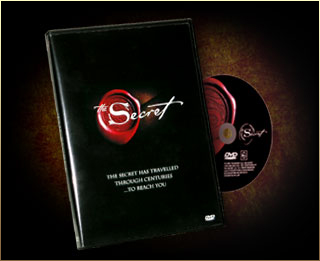
"The Secret" - New Age Economics of Abundance


"This is 'The Secret' to everything - the secret to unlimited joy, health, money, relationships, love, youth: everything you have ever wanted."


"The Secret" is the latest hit-movie sweeping the New Age-community. It comes hot on the heels of “What the Bleep” which introduced us to what was long known to science, that our universe is not a static construct that works according to the Newtonian laws of cause and effect only. The Secret now takes us into the area of personal success, and how one can achieve it using the universal Law of Attraction.


It is telling that we still see 'success' mostly in terms consumerism and of how much stuff we can buy. Watching that movie, I several times felt I was watching a long and extended commercial for luxury cars or real estate.


I'm all for applying the Law of Attraction and working with Intentions set to achieve personal goals in life: I myself have experienced incredible results with it. However, I wonder: When do we move away from individual desires and reckless consumerism to a planetary family with a concern for a collective welfare that is ecologically sustainable?


I always felt that the new age 'economics of abundance' is a bit one-sided and naive. Just 'attracting' (monetary) wealth to a particular person does nothing to change the much deeper problems of a flawed money system and economic ideology that prevents goods and services to be distributed fairly among the people at the first place.

20 October 2006

The Nobel Prize

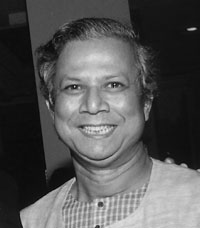
Muhammad Yunus, a Bangladeshi banker and economist and founder of the Grameen Bank, won this years Nobel Peace Prize (together with the Grameen Bank) "for their efforts to create economic and social development from below."

Yunus is said to be the developer of the concept of microcredit, giving small loans to entrepreneurs who are too poor to qualify for a conventional bank loan. The Grameen Bank (literally, "Bank of the Villages", was founded in 1976 and has issued more than US$ 5.1 billion to 5.3 million borrowers.

His stated vision is to reduce world poverty by 50 percent by 2015.

“Poverty is not created by poor people,” advocates Yunus. “It is created by the concepts and institutional arrangements under which people live.”

It is interesting that he received the Nobel Peace Prize, and not the Nobel Prize for Economics. Might this be because this person has actually done something concrete and helped real human beings - and not just formulated yet another theory based on some abstract concepts that are totally divorced from most people's reality - as most economic theories and concepts invariably seem to be ....?

12 October 2006

Unemployed?

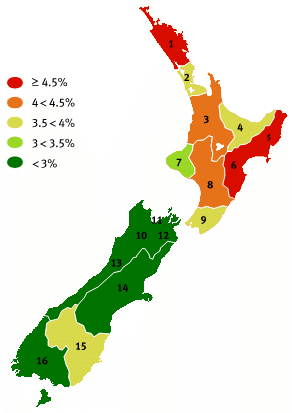
The New Zealand Social Report 2006 reports that in 2005 3.7% of the labour force were unemployed and actively seeking work. Sounds really good, eh?


But what does that really mean?

On the next page of the same report it says that in 2005, 74.6% of 15-64 year olds were employed for one hour or more per week. Wouldn't that mean that effectively 25,4% of all 15-64 year olds were unemployed?

Measuring unemployment seems to be a very dodgy thing. It is only indirectly connected with the number of people who are actually not working at all or working without pay. Many people seem to fall through the cracks of this statistic, like:

  • Those who have lost their jobs and have become discouraged over time from actively looking for work.
  • Those who are self-employed or wish to become self-employed, such as tradesmen or building contractors or IT consultants.
  • Those who have retired before the official retirement age but would still like to work.
  • Those on disability pensions who, while not possessing full health, still wish to work in occupations suitable for their medical conditions.
  • Those who work for payment for as little as one hour per week but would like to work full-time. These people are "involuntary part-time" workers.
  • Those who are underemployed, e.g., a computer programmer who is working in a retail store until he can find a permanent job.
And what about those people who do essential community work, like raising children, helping their neighbours and volunteering for a local not-for-profit organisation? This kind of activities are completely igonored by our social and economic reporting methods.

08 October 2006

Solidarity Economics


But what exactly is this "solidarity economy approach"? For some theorists of the movement, it begins with a redefinition of economic space itself. The dominant neoclassical story paints the economy as a singular space in which market actors (firms or individuals) seek to maximize their gain in a context of scarce resources. These actors play out their profit-seeking dramas on a stage wholly defined by the dynamics of the market and the state. Countering this narrow approach, solidarity economics embraces a plural and cultural view of the economy as a complex space of social relationship in which individuals, communities, and organizations generate livelihoods through many different means and with many different motivations and aspirations—not just the maximization of individual gain. The economic activity validated by neoclassical economists represents, in this view, only a tiny fraction of human efforts to meet needs and fulfill desires.

* * *

At its core, solidarity economics rejects one-size-fits-all solutions and singular economic blueprints, embracing instead a view that economic and social development should occur from the bottom up, diversely and creatively crafted by those who are most affected.

* * *

Unlike many alternative economic projects that have come before, solidarity economics does not seek to build a singular model of how the economy should be structured, but rather pursues a dynamic process of economic organizing in which organizations, communities, and social movements work to identify, strengthen, connect, and create democratic and liberatory means of meeting their needs.

* * *

This is, perhaps, the heart of solidarity economics—the process of networking diverse structures that share common values in ways that strengthen each.


* * *

This, to me, sounds like an approach to economics that allows for a natural evolution of a healthy and diverse society, and that allows for happy people!

If you want to read more about this topic, go here:
- http://dollarsandsense.org/archives/2006/0706emiller.html
- http://www.geo.coop/SolidarityEconomicsEthanMiller.htm
- http://www.jesuit.ie/ijnd/SolidarityEconomics.pdf

06 October 2006

Start asking the right question: "What is the economy for, anyway?"


Maybe we need to start learning to ask the right questions! All that is asked nowadays, is "But what will that do to the economy?" - usually putting us into the defense right away - because of course nobody wants to do anything that is bad for the economy!

However, what "economy" are we talking about? It's the one of unlimited exponential growth and stock market speculation. It's one where the only measure of success is the Gross Domestic Product (GDP) or stock prices.

What about an economy that would give us health, knowledge, kindness, equality for the greatest numbers, access to opportunity, a healthy democracy, a sustainable environment and happy and fulfilled people?

Read this inspiring article by John de Graaf: What's the Economy for, Anyway?

03 October 2006

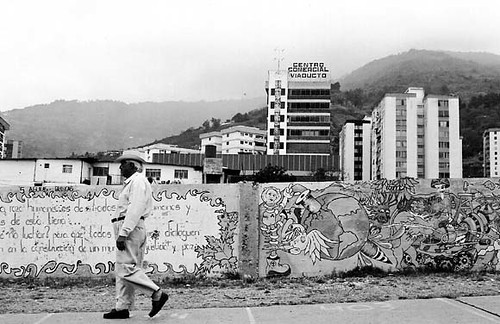
Venezuela's Oil Wealth Funds Gusher of Anti-Poverty Projects

While the Venezuelan president has caused international controversy with his angry denunciations of the Bush administration, this is where the rubber meets the road for Chavez's radical rhetoric. He is spending billions of dollars on anti-poverty programs, in what experts say may amount to the largest such effort in a developing nation.

Read the whole article at Commondreams.org!

Will be interesting to see how successfully Venezuela will be able to make good use of the oil millions ...