Today we have bigger houses and smaller families;
more conveniences, but less time;
we have more degrees, but less common sense;
more knowledge, but less judgment;
We have more experts, and also more problems;
more medicine, but less wellness.
We spend too recklessly, laugh too little, drive too fast, get to angry too quickly, stay up too late, get up too tired, read too little, watch TV too often, and pray too seldom.
We have multiplied our possessions, but reduced our values.
We talk too much, love too little and lie too often.
We‘ve learned how to make a living, but not a life;
we’ve added years to life, not life to years.
We have taller buildings, but shorter tempers;
wider freeways, but narrower viewpoints.
We spend more, but have less;
we buy more, but enjoy it less
We've been all the way to the moon and back,
but have trouble crossing the street to meet the new neighbour
We've conquered outer space, but not inner space.
We've split the atom, but not our prejudice;
we write more, but learn less;
plan more, but accomplish less
We've learned to rush, but not to wait;
we have higher incomes, but lower morals.
We are long on quantity, but short on quality
These are the times of fast foods and slow digestion;
tall men and short character;
steep profits and shallow relationships.
More leisure and less fun;
more kinds of food, and less nutrition;
two incomes, and more divorce;
fancier houses, and broken homes
03 April 2007


01 April 2007
Section 59 – or what about non-violent parenting?
 (Will the popular childrens series Pingu be banned in New Zealand?)
Currently there is an interesting public discussion making waves in New Zealand. It is about the proposed repeal of section 59 of the Crimes Act, brought before parliament by Green Party MP Sue Bradford. The purpose of this Bill is to stop force, and associated violence being inflicted on children in the context of correction and discipline.
The discussion has been noisy, even strident and unpleasant. Is this just a popular political side-show, or how deep does this issue really go? If we can believe the opponents of the bill, then a police state is being born here, and personal freedom of parents to discipline their misbehaving children is severely restricted or even being taken away. An essential part of the Kiwi way of life and culture is about being legislated away and lost – or so most god-fearing Christians like make us believe.
In our constant endeavour to create a civilised and evolved society where do we draw the line? Should it be legal to hit your children, but not your wife and animals? In the Koran, the holy book of Islam, the line is drawn in Surah IV, Verse 34, which states that if the woman doesn't obey the man, they should be beaten (though the situation is not always as clearcut). Now, we all 'know' that Islam is the enemy of our culture – they mistreat women and sanction their beatings. We in New Zealand, would never do that - yet it should be our god-given right to beat our children?
This society is still steeped in institutional violence. How otherwise would one explain the uproar at a bill that basically wants to make non-violent parenting the norm? Our violence is not just against children and a variety of other people, it is also against nature and the environment. We've abused and mistreated the planet to an extent that we are now facing global climate change.
We may have experienced incredible technological advances over the last century. We have also learned a lot about how to educate children, and we know that hitting them is counterproductive if anything. However, we also need to match those advances with moral and ethical evolution as well. The opposition to this bill just shows that we have much more difficulty to mature ethically and morally than we have adopting new technological gadgets. And it shows that we still have long way to go until a non-violent society becomes the norm.
23 March 2007
Mainstream Press takes up Flooding Story
Today, Christchurch's main paper The Press published a story and a picture on the potential chance for half the city to be flooded by rising sealevels. It's exactly the same I reported on in this blog on 3 November last year already!
10 March 2007
Fresh Fruits and Vegetables
The other day I went vegetable and fruit shopping at a market garden at the outskirts of the city...


03 February 2007
What is Sustainability?
In my understanding of sustainability it is not "if" some area of our society has relevance to sustainability - all have! To me, sustainability is a way of looking at things (and at the same time a way of life). Either you look from/through a paradigm of sustainability - or not!
In the future it will be irrelevant if you are Christian or Muslim, Chinese or American - the cultural divide will be between those who live a sustainable life-style and those who do not (at the expense of everything and everyone else on the planet)!
In the future it will be irrelevant if you are Christian or Muslim, Chinese or American - the cultural divide will be between those who live a sustainable life-style and those who do not (at the expense of everything and everyone else on the planet)!
08 January 2007
What is Fascism?
We live in times were we risk losing many of our freedoms gained in our western democracies. When the political culture in a country turns sour, it often turns into some sort of fascism. I think it is quite important to recognize the signs of creeping fascism early! Political scientist Dr. Lawrence Britt studied several typical fascist regimes of the last century and found that they all had certain aspects in common. Here are 14 characteristics of fascism:
1. Powerful and Continuing Nationalism
Fascist regimes tend to make constant use of patriotic mottoes, slogans, symbols, songs, and other paraphernalia. Flags are seen everywhere, as are flag symbols on clothing and in public displays.
2. Disdain for the Recognition of Human Rights
Because of fear of enemies and the need for security, the people in fascist regimes are persuaded that human rights can be ignored in certain cases because of "need." The people tend to look the other way or even approve of torture, summary executions, assassinations, long incarcerations of prisoners, etc.
3. Identification of Enemies/Scapegoats as a Unifying Cause
The people are rallied into a unifying patriotic frenzy over the need to eliminate a perceived common threat or foe: racial , ethnic or religious minorities; liberals; communists; socialists, terrorists, etc.
4. Supremacy of the Military
Even when there are widespread domestic problems, the military is given a disproportionate amount of government funding, and the domestic agenda is neglected. Soldiers and military service are glamorized.
5. Rampant Sexism
The governments of fascist nations tend to be almost exclusively male-dominated. Under fascist regimes, traditional gender roles are made more rigid. Opposition to abortion is high, as is homophobia and anti-gay legislation and national policy.
6. Controlled Mass Media
Sometimes the media is directly controlled by the government, but in other cases, the media is indirectly controlled by government regulation, or sympathetic media spokespeople and executives. Censorship, especially in war time, is very common.
7. Obsession with National Security
Fear is used as a motivational tool by the government over the masses.
8. Religion and Government are Intertwined
Governments in fascist nations tend to use the most common religion in the nation as a tool to manipulate public opinion. Religious rhetoric and terminology is common from government leaders, even when the major tenets of the religion are diametrically opposed to the government's policies or actions.
9. Corporate Power is Protected
The industrial and business aristocracy of a fascist nation often are the ones who put the government leaders into power, creating a mutually beneficial business/government relationship and power elite.
10. Labor Power is Suppressed
Because the organizing power of labor is the only real threat to a fascist government, labor unions are either eliminated entirely, or are severely suppressed .
11. Disdain for Intellectuals and the Arts
Fascist nations tend to promote and tolerate open hostility to higher education, and academia. It is not uncommon for professors and other academics to be censored or even arrested. Free expression in the arts is openly attacked, and governments often refuse to fund the arts.
12. Obsession with Crime and Punishment
Under fascist regimes, the police are given almost limitless power to enforce laws. The people are often willing to overlook police abuses and even forego civil liberties in the name of patriotism. There is often a national police force with virtually unlimited power in fascist nations.
13. Rampant Cronyism and Corruption
Fascist regimes almost always are governed by groups of friends and associates who appoint each other to government positions and use governmental power and authority to protect their friends from accountability. It is not uncommon in fascist regimes for national resources and even treasures to be appropriated or even outright stolen by government leaders.
14. Fraudulent Elections
Sometimes elections in fascist nations are a complete sham. Other times elections are manipulated by smear campaigns against or even assassination of opposition candidates, use of legislation to control voting numbers or political district boundaries, and manipulation of the media. Fascist nations also typically use their judiciaries to manipulate or control elections.
Read more here!
1. Powerful and Continuing Nationalism
Fascist regimes tend to make constant use of patriotic mottoes, slogans, symbols, songs, and other paraphernalia. Flags are seen everywhere, as are flag symbols on clothing and in public displays.
2. Disdain for the Recognition of Human Rights
Because of fear of enemies and the need for security, the people in fascist regimes are persuaded that human rights can be ignored in certain cases because of "need." The people tend to look the other way or even approve of torture, summary executions, assassinations, long incarcerations of prisoners, etc.
3. Identification of Enemies/Scapegoats as a Unifying Cause
The people are rallied into a unifying patriotic frenzy over the need to eliminate a perceived common threat or foe: racial , ethnic or religious minorities; liberals; communists; socialists, terrorists, etc.
4. Supremacy of the Military
Even when there are widespread domestic problems, the military is given a disproportionate amount of government funding, and the domestic agenda is neglected. Soldiers and military service are glamorized.
5. Rampant Sexism
The governments of fascist nations tend to be almost exclusively male-dominated. Under fascist regimes, traditional gender roles are made more rigid. Opposition to abortion is high, as is homophobia and anti-gay legislation and national policy.
6. Controlled Mass Media
Sometimes the media is directly controlled by the government, but in other cases, the media is indirectly controlled by government regulation, or sympathetic media spokespeople and executives. Censorship, especially in war time, is very common.
7. Obsession with National Security
Fear is used as a motivational tool by the government over the masses.
8. Religion and Government are Intertwined
Governments in fascist nations tend to use the most common religion in the nation as a tool to manipulate public opinion. Religious rhetoric and terminology is common from government leaders, even when the major tenets of the religion are diametrically opposed to the government's policies or actions.
9. Corporate Power is Protected
The industrial and business aristocracy of a fascist nation often are the ones who put the government leaders into power, creating a mutually beneficial business/government relationship and power elite.
10. Labor Power is Suppressed
Because the organizing power of labor is the only real threat to a fascist government, labor unions are either eliminated entirely, or are severely suppressed .
11. Disdain for Intellectuals and the Arts
Fascist nations tend to promote and tolerate open hostility to higher education, and academia. It is not uncommon for professors and other academics to be censored or even arrested. Free expression in the arts is openly attacked, and governments often refuse to fund the arts.
12. Obsession with Crime and Punishment
Under fascist regimes, the police are given almost limitless power to enforce laws. The people are often willing to overlook police abuses and even forego civil liberties in the name of patriotism. There is often a national police force with virtually unlimited power in fascist nations.
13. Rampant Cronyism and Corruption
Fascist regimes almost always are governed by groups of friends and associates who appoint each other to government positions and use governmental power and authority to protect their friends from accountability. It is not uncommon in fascist regimes for national resources and even treasures to be appropriated or even outright stolen by government leaders.
14. Fraudulent Elections
Sometimes elections in fascist nations are a complete sham. Other times elections are manipulated by smear campaigns against or even assassination of opposition candidates, use of legislation to control voting numbers or political district boundaries, and manipulation of the media. Fascist nations also typically use their judiciaries to manipulate or control elections.
Read more here!
30 December 2006
The Seas are Rising
For the first time, an inhabited island has disappeared beneath rising seas.

Rising seas, caused by global warming, have for the first time washed an inhabited island off the face of the Earth. The obliteration of Lohachara island, in India's part of the Sundarbans where the Ganges and the Brahmaputra rivers empty into the Bay of Bengal, marks the moment when one of the most apocalyptic predictions of environmentalists and climate scientists has started coming true.
Read the whole article by The Independent
28 December 2006
A community bank with its own currency
See here a video from Brazil, of a small community that created its own bank and currency:
13 December 2006
Sustainability Background Papers

I'd like to point you to a series of interesting papers, posted at the website of the Parliamentary Commissioner of the Environment. They are background papers on a series of issues. They are all important, yet I'd like to emphasise a few:
by Anew NZSignificant work on progress indicators is taking place in New Zealand but the challenge is to achieve integration and comparability of the diverse indicator sets. Gross Domestic Product should no longer be used as a key indicator of society's well-being. Six action steps are recommended.
* Corporate sustainability reporting in New Zealand (0.3 MB pdf)by Kerry Griffiths and Julia LindesayThe emergence of triple bottom line (TBL) reporting in New Zealand, where stakeholder demands for information and transparency are not as strong as they are internationally.
* Lyttelton working towards sustainability: A case study of Project Port Lyttelton, a community group acting as catalyst (4.1 MB pdf)by Margaret Jefferies and Wendy EveringhamProject Port Lyttelton is a grass roots community group that works to bring about a sustainable world locally. An exploration of aspects including communication, values, networking, and taking risks, and a review of several Lyttelton projects.
* Sustainability in New Zealand - Lifting the game (0.5 MB pdf)by John PeetOur economy's relationships with the natural environment, society and our institutional framework are not sustainable. To move forward we need a national strategy for sustainable development and policy tools including ecotaxes and tradeable permits.
by Robert Vale and Charles EasonSustainability seen in terms of self-reliant, resilient, and resource efficient housing, of which few New Zealand examples exist. Sustainable housing means new buildings and neighbourhoods with zero non-renewable energy consumption to suit a range of tastes and incomes.
Novye Atagi, 10 years on

In a few days there will be the 10th anniversary of the massacre of international Red Cross aid workers in the small chechen town of Novye Atagi. Six aid workers, 5 nurses and a construction engineer, were killed in the early morning hours of the 17 December 1996, in a premeditated attack on their sleeping quarters. The expatriates were workers in a small war-surgical hospital. This was the single worst incident that ICRC ever experienced in its entire history. The people who lost their lives were:
Fernanda Calado, an ICRC nurse of Spanish nationality
Ingeborg Foss, a nurse from the Norwegian Red Cross
Nancy Malloy, a medical administrator from the Canadian Red Cross
Gunnhild Myklebust, a nurse from the Norwegian Red Cross
Sheryl Thayer, a nurse from the New Zealand Red Cross
Hans Elkerbout, a construction technician from the Netherlands Red Cross.
Links:
- CRIMINAL CASE NO. 96620018, GlobalSecurity.org
***
On the 17th and 18th December commemorative events will be held at ICRC in Geneva, Switzerland. Also at this occassion, medals will be given to those who died working for ICRC recently:
Mrs. Jeannette Waddell Fournier (who died on 2.9.2006 in Senegal)
Mr. Salih Ibrahim Hassan (who died on 16.8.2006 in Soudan)
Mr. Samir Kadhum Jwad Al-Karady (who died on 13.1.2005 in Irak)
02 December 2006
More on Local Currencies
An earlier posting on complementary currencies and its importance in a local economy created some discussions. I'd like to comment further on that. This is also in response to two messages that went over the Living Economies mailing list. You can read them here and here.
Giving it some deeper thought, it is not the actually the circulation of money locally that is ultimately important, but the CREATION of money locally.
There are several different ways that money can be created. It depends if a particular currency is cash-based or if it is wealth-based. Mutual credit currencies like LETS are created as a debt – and there is nothing wrong with that. In LETS, the debt incurred by currency creation is a debt to a community of people. In the conventional money system, the debt is incurred to a (often international) bank. The process used by banks to create money is called fractional reserve banking. This process has an additional twist: the payment of interest. It is the involvement of interest in the money creation process which is at the core of the problem, which contributes to the constant redistribution of wealth from the poor to the rich, the redistribution from the fringes to the centre and, I believe, it is also ultimately responsible for our environmentally destructive economics.
Therefore the best way to address those problems is to issue money locally, in a healthy way. Give the power to issue money to the people instead of businesses.
 (picture: 10 slices of Burlington Bread, USA, issued interest free)
The second posting sounded to me a bit like neo-liberal propaganda. The writer shows little or no understanding of complementary currency and how it might be applied to local economics.
It is a common misconception that when we say 'interest-free', we mean that money shouldn't give any return when invested. We may debate if getting an income without work (that is what returns on investments are), especially when little or no risks are involved, is ethical or not. The writer himself wrote that “The core problem is the human desire to get more of something for less work on their part.”
However, the real issue around interest-free money is how this money is created. He writes that 'creating alternative currencies which do not permit interest are complicated' – the actual fact is that virtually all complementary currencies are created without interest.
Again, any discussion of this topic is only meaningful if the process of fractional reserve banking is understood. When licensed banks create money by loaning it to their customers with interest, then scarcity is created, together with all the resulting negative effects. It is key to understand that more than 98% of the money supply is created by loans incurring interest (Reserve Bank of New Zealand figures). If all that money is due to be paid back, plus interest – where does the additional money for the interest come from? Fractional reserve banking has an influence on the money supply. Here in NZ we have the additional twist to the story that any reserve ratio has been abolished in 1985; monetary policy is entirely conducted by the setting of interest rates.
When credit unions loan money to their members against interest, then no new money is created, and therefore the interest charged has no influence on the money supply as a whole. Neither does interest returned on investments influence the money supply. While it is possible to issue a complementary currency without interest, it would also be possible to invest it with interest returned on investments. However, where interest is involved, one always creates a redistribution mechanism that funnels money from the poor to the rich ...
That is why it is important to note that ancient religious prohibitions against usury (interest) applied to all kinds of interest taking. From that arose the principles of islamic banking for example, which prohibits interest taking, and promotes among other things the sharing of profit and loss and joint-venture.
01 December 2006
Breaking Ice
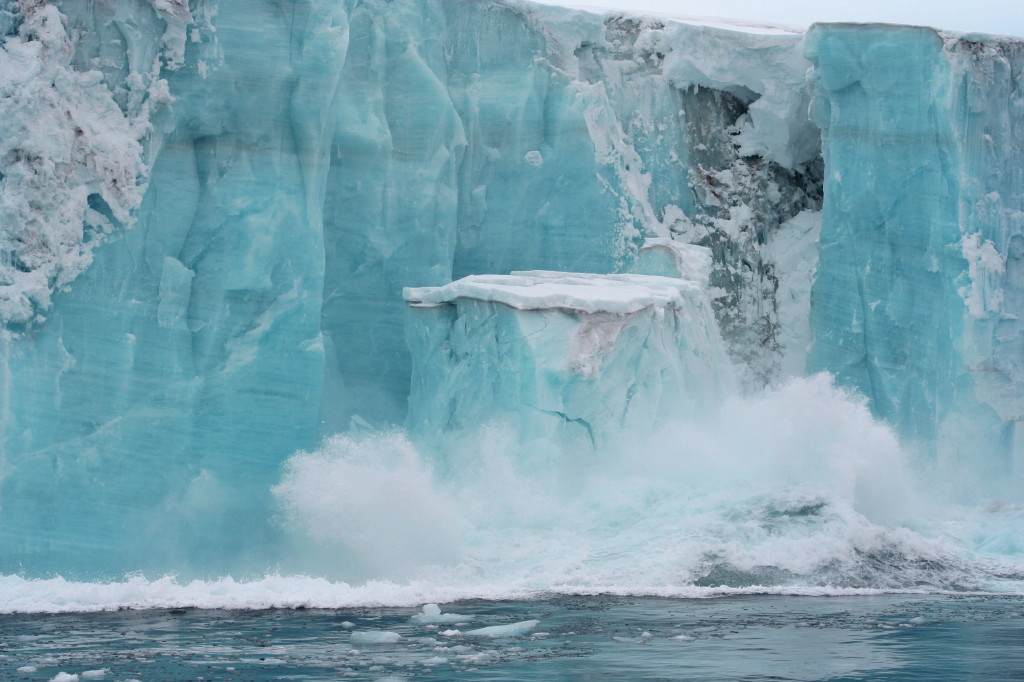
Climate change and its effects on our planet is still high on my mind. Yesterday and today I came across a number of articles dealing with the effects of climate change.
The first one was an article in The Press reporting on the findings of a New Zealand-led drilling team in Antarctica, who has recovered three million year of climate history. The conclude that the Ross Ice Shelf, a raft of ice the size of France, could collapse quickly, triggering a dramatic rise in sea levels. History indicates that if the ice shelf collapses, it will do so suddenly and quickly. That was also proven in 2002 when the Larsen Ice Shelf extremely quickly collapsed.
In January, British Antarctic Survey researchers predicted that its collapse would make sea levels rise by at least 5m, with other estimates predicting a rise of up to 17m.
At the same time, James Lovelock, who is famous for the Gaia hypothesis, depicting the planet as a living being, predicted that large parts of the planet will become uninhabitable. He estimates that only about one tenth of Earth's population will be able to survive. He estimates that the temperatures on Earth will rise up to 8C, and that our current efforts will be mostly meaningless. Warming will be driven by a feedback loop that we cannot influence anymore. (see http://www.commondreams.org/headlines06/1129-05.htm)
Maybe a prospect too depressing to contemplate ...
(Photo by Yukon White Light)
Subscribe to:
Posts (Atom)


